
Fiber Fun
Saturday, September 28, 2019

Saturday, June 15, 2019
MCSA For Windows 10 Badge & Just Passed MCP For windows Server 2012 Install & Configure
Microsoft no longer issues certifications for MCP - the two I have from before February of 2019 are grandfathered. You have to complete a full MCSA series of exams before a Microsoft certificate is issued. You CAN, however, get badges via Acclaim based on the email address you registered with Microsoft for your exams. Reference THIS ARTICLE:


Friday, May 31, 2019


Wednesday, March 6, 2019
Explanation Of What IP Broadcast Messages Are Actually USED For...
I have had a really tough time finding a decent and easily-understood explanation of how broadcast messages are actually used in IP networking. Most articles online simply explain what broadcast messages are, but leave how they are used up to the imagination.
This article from Homenet How-To is the best I have found to-date:
https://www.homenethowto.com/switching/broadcasts/
Dan
This article from Homenet How-To is the best I have found to-date:
https://www.homenethowto.com/switching/broadcasts/
Dan
Tuesday, October 2, 2018
Why Is A power Button Symbol A Zero With A One Stuck In It?
"For a
CMOS gate operating at a power supply voltage of 5 volts, the
acceptable input signal voltages range from0 volts to 1.5 volts for
a “low” logic state, and 3.5 volts to 5 volts for
a “high” logic state."
HIGH = 1 = ON
LOW = 0 =
OFF
Binary 1 = +3.5 - +5 VDC = ON = HIGH
Binary 0 = 0 VDC - + 1.5 VDC = OFF = LOW
128|064|032|016|008|004|002|001
000|000|000|000|000|000|000|000 = 0
000|000|000|000|000|000|000|001 = 1
("One" bit is turned on)
000|000|000|000|000|000|001|000 = 2
("Two" bit is turned on)
000|000|000|000|000|001|000|000 = 4
("Four" bit is turned on)
000|000|000|000|001|000|000|001 =
9 ("One" bit + "Eight" bit turned on) (1+8)
000|001|000|000|001|000|000|000 =
72 ("Sixty Four" bit + "Eight" bit turned on)(64+8)
If you were to read the voltages in a memory chip address,
there would be a series of 1's & 0's, with the 1's represented by a voltage
of +3.5 to +5 volts, and the zeroes represented by a voltage of 0
to + 1.5 Volts. You would need a REALLY tiny voltmeter probe, but that's
what would be in the chip.
Ones are ON, zeroes are OFF.
Now look at the symbol on your power button. You have the
choice of ON or OFF. One or Zero.


Monday, September 24, 2018
All About 66-Block Punchdown For Alarms And Telecommunications
66
Blocks are the classic old-school telecommunications wiring
punch-down block.
These
blocks have been and are used for:
- POTS (Plain Old Telephone Service) Lines
- Analog and digital DS0 data circuits. (2400 bps – 64Kbps)
- T1 lines. (4 wires, 24 channels [USA], 1.544 Mbps digital)
- Low-voltage alarm wiring for equipment alarms, door and window sensors, fire alarms, HVAC unit alarms, Emergency generator alarms, etc.
- Traditional PBX business office phone systems.
- CCTV Camera power leads.
Odds
are high that if you run into an active 66-block in the field, it
will be used for low-voltage alarm wiring. However, you can never
assume that it’s not legacy services still running some of the
above-mentioned uses. Railroads,
for instance, still use analog DS0 circuits to control track switches
and crossing signals. You do NOT want to be the technician who breaks
one of those!
What
follows are graphics and explanations of various facts regarding
66-blocks.

66-Block
with wiring punched down. Left pin pair are electrically connected,
right pair are, but left is insulated from right.
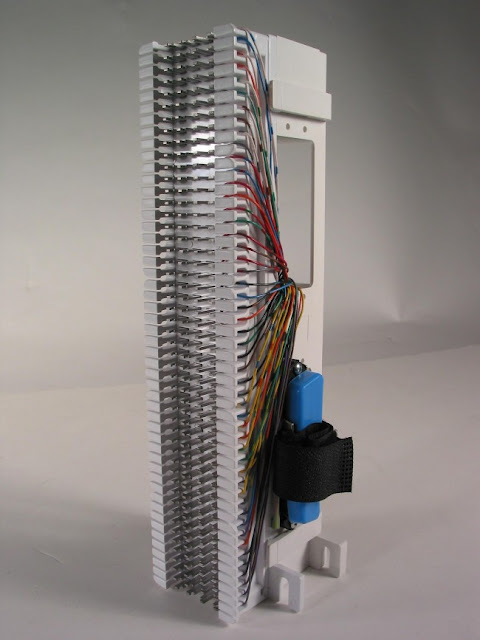

Pre-wired
25-pair 66-Block with standard telecommunications color code.
Pre-wiring goes to the female Amphenol connector on the side of the
block. (Shown with dust cap)

Pre-wired
66-block with 25-pair Amphenol cable. (Male)


Female
Amphenol connector

Male
Amphenol connector.

Note
the bridge clips being used to connect the left pin pair to the
right. These are used to easily isolate one side of the wiring from
the other, and just as quickly restore the connection. This is an
extremely useful feature in troubleshooting wiring and equipment
faults.

Punching
down wiring on a 66-block. The underside of the tool cuts excess wire
away to prevent shorts.
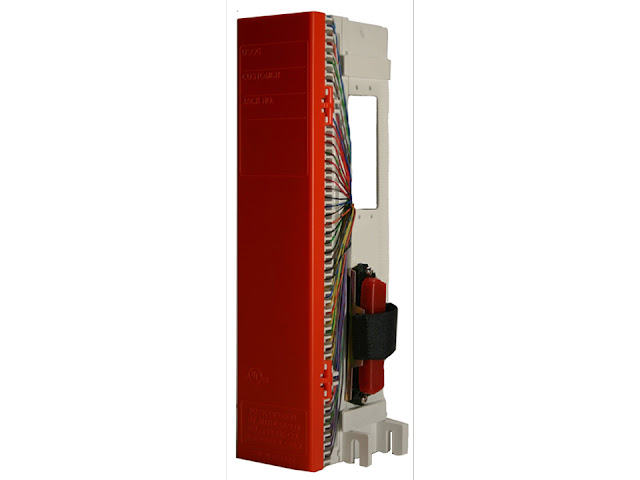

Watch
for 66-Blocks with orange dust covers. ESPECIALLY if they have
“RJ-21X”
on the cover. An RJ-21X jack is a telecommunications provider
demarcation
point.
The telecommunications provider owns one side of the block (Usually
the side with the Amphenol pre-wire), and the customer may punch
their equipment wiring down on the other side. This allows the
telecom provider to isolate their service lines from the customer
equipment by simply removing the bridge clips for a particular
circuit during troubleshooting. The telecomm provider’s
responsibility ends at their side of the RJ-21X.

Creating
circuit loop-backs or extensions with 66-blocks. There are 66-block
punch-down buts for punch-down tools that DO NOT have a cutting side.
They can punch the wires down intact without cutting them. In the
above picture, all the left-side pins of the same color are
electrically connected because the wire is punched down, but not cut.

Standard
25-pair color code:
Pair
colors:
Blue, Orange, Green, Brown, Slate (Gray).
Tracer
colors:
White, Red, Black, Yellow, Violet.
More
Color Code Charts:


Wikipedia
on Telecomm wiring color codes:
Can you spot the Telco demarc in this picture?

Nice
spaghetti bowl there…

66-Blocks
offer a lot more wiring flexibility than 110-block RJ45 patch panels,
but are rarely used for Ethernet. There’s too much chance for
electrical or inductive interference with the sensitive data signal
at Ethernet speeds. However if you see these blocks in the field,
you’ll now have some idea what you may be looking at.
Thank you for reading through!
Dan
Stafford
Subscribe to:
Posts (Atom)